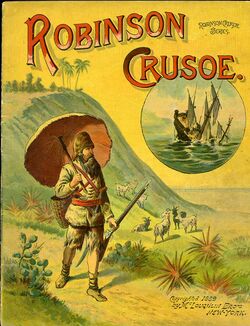
Daniel Defoe’ Robinson Crusoe takes an important place in the history of the English novel, because it was the first time that a continuous prose narrative had been written with the specific aim of creating the illusion of day-to-day living. Robinson Crusoe is very much a product of his age, the individualistic-minded eighteenth century. The Economic Individualism in Robison Crusoe illustrates the attitudes of a eighteenth century British citizen.
In conclusion, in Robinson Crusoe, Daniel Defoe has created a character that establishes the individual of modern capitalism. In his circumstance of isolation on a deserted island, and also in his discovery of God therein, Defoe finds the opportunity to demonstrate the Protestant work ethic in action. Through the portrayal of the work ethic we discover the emergence of capitalism and individualism, both advancing in tandem.
We can notice that Defoe concentrates on Crusoe struggles with practical problems. Robison Crusoe is an illustration ofhomo economicus, that is, economic man that symbolizes the new outlook of individualism in its economic aspect. All Defoe’s heroes pursue money, and we can see this very clearly in Robinson Crusoe – the story begins Robinson Crusoe going to his Brazilian plantation, however his ship was wrecked and he was the only survivor in an island.
This essay will compare the two novels, Robinson Crusoe and Lord of the Flies, to see how each author reflected the point of view of society at the time that they lived in. The nature of civilisation will be viewed from their two different perspectives. Daniel Defoe published Robinson Crusoe in 1719; William Golding published Lord of the Flies in 1954.
In popular imagination Daniel Defoe’s Robinson Crusoe has become an adventure story for children, for which the original novel is not responsible, but the abridged and bowdlerized versions must be blamed. A close reading of the original text reveals a novel of enormous significance. In many ways the novel can be said to be defining the modern citizen of capitalistic society.
Therefore, Daniel Defoe was familiar with this practise, even though he did not actively criticise it. There is consequently no surprise that, Robinson treats Friday as his slave. However, Crusoe is able to recognise Friday’s humanity, though he does not see his slavery as a contradiction. Robinson Crusoe was written in a context of a European colonialism well established around the globe.
In this process society is minimized and personal needs are maximized. The obsession of the economist is with personal desires, and so he is happy to push society to the distance. In Robinson Crusoe’s plight Defoe has created a situation which attracts the gaze of the economist compulsively. Defoe does not disappoint; along with the religious awakening of Crusoe we are also given a meticulous account of his economic situation.
There is even a section which is strictly in the diary format, which Defoe abandons after a point, with the excuse that Crusoe had run out of paper and ink. In truth it is a desperate attempt at realism, and Defoe only discards it when he sees that it is impeding the flow of the narrative, and that the last is more important. It must be kept in mind that Robinson Crusoe is not yet a novel, but is striving to become one.
That technique could have been influenced by the fact that Daniel Defoe was also a journalist. Concisely, Defoe’s plot is simpler with only one main plot arousing the reader’s imagination more than possible burning issues.
To conclude, Robinson Crusoe is a novel in itself, since it includes all the characteristics: characters, plot, and narrative voice.
 English Literature with Kamran Abbas Shah
Leave a comment